

Photo by Unseen Studio on Unsplash
“You’re doing it on purpose, right?” an American student asked me during one of our first classes.
“What?” I had no idea what he was talking about.
“The grammar! You’re doing it on purpose to make Polish the most complicated language in the world! And you’re proud of it!”
I wasn’t quite sure whether he was joking. His laughter sounded a little forced, and, if I’m honest, so did mine.
But I immediately understood one thing: this student was probably not going to be a big fan of lessons packed with grammatical structures, endings and exercises.
And that was fine. That’s not really my style either.
Still, grammar is an essential part of learning any language, and sooner or later, we have to face it. So I had to find a way to introduce Polish grammar without making my student want to run for the nearest exit.
I explained that all he really needed was patience. And a sense of humour. A little emotional resilience wouldn’t hurt either. And, most importantly, the belief that YES, Polish grammar CAN be learnt.
So, how do you learn Polish grammar without giving up on the very first day?
1. Don’t try to learn everything at once.

Photo by Imagine Buddy on Unsplash
There are seven cases in Polish. Yes, seven. But you don’t need to know all of them from day one. Or day two. You don’t even need to know all of them after a year of studying Polish – and that’s completely fine.
Some cases are relatively straightforward, while others require a bit more memorisation and understanding. But you don’t need to sit down with a terrifying grammar table and memorise every single ending.
Instead, learn Polish phrases and expressions that you can actually use. Grammar makes much more sense when you see it in context – and, more importantly, when you have a reason to use it.
2. Say tak to repetitive exercises.
And tak means “yes”, of course. 🙂
During my classes, we don’t usually sit around doing exercise after exercise. We practise grammar through conversation instead.
However, there is homework. And this is where repetitive exercises can actually be your friend.
Not everyone is a fan of grammar drills (am I the only one raising my hand here?), but they really are useful. If you practise something once during class, there’s a good chance you’ll forget it an hour later. But if you come back to it the next day, and then again a few days later, something interesting starts to happen.
The words and structures become familiar. Then they become automatic. And eventually, they start rolling off your tongue without you having to stop and think about which ending you need.
That’s exactly what we want!
3. “I only want to speak Polish. I don’t care about grammar as long as people understand me.”
Bad news: people might not understand you.
Well, they might understand some things.
If you say “Me. Want. Coffee” in English, for example, most people will probably understand what you mean. The same is true in Polish. If that is the level you are comfortable with, and your only goal is to communicate basic needs, then you probably don’t need to worry too much about grammar.
But if you want to say something a bit more complicated, you are going to need some grammatical structures.
Polish is a highly inflected language, which means that words change their forms depending on the context in which they are used. Grammar is therefore not just a collection of arbitrary rules designed to make your life difficult. It is what allows you to express more complex ideas.
Of course, this doesn’t mean that you need to memorise an entire grammar book before saying your first sentence!
Learn grammar gradually and naturally. And remember: mistakes are part of the learning process.
4. Made a mistake? It’s not the end of the world!
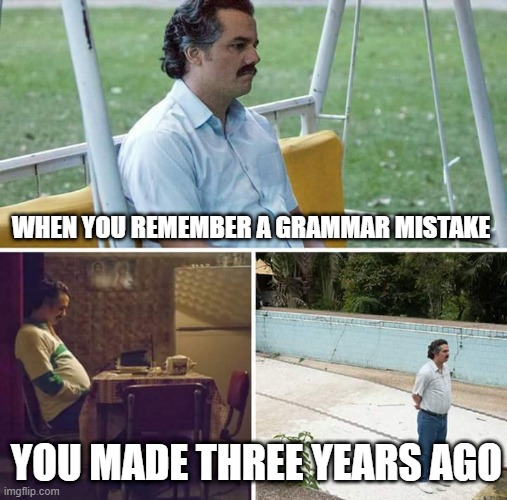
Accept that your Polish is going to be a little messy at first. Actually, probably for quite a while.
You will use the wrong ending. You will mix up cases. You will forget a word you knew perfectly well five minutes earlier.
That’s normal.
And here’s some good news: Polish people are usually genuinely delighted when a foreigner makes an effort to speak Polish. So forget about perfection and just speak, speak, speak!
You can always correct the grammar later.
5. Learn useful phrases rather than theoretical rules.
Instead of thinking:
“Right. Today I am going to memorise all the endings of the Accusative case.”
Try thinking:
“Today I am going to learn how to order food in a restaurant.”
Suddenly, grammar becomes a little less terrifying.
For example:
- Poproszę kawę. – Coffee, please.
- Poproszę wodę. – Water, please.
- Poproszę rachunek. – The bill, please.
You are using the Accusative case in all of these sentences. But instead of memorising a table of endings, you are learning grammar while learning something you can actually say.
And this is one of the best ways to make grammar stick.
When grammar is attached to sentences you actually use, it becomes much easier to remember. With enough practice, grammatical structures become something you feel rather than something you consciously calculate.
In other words, don’t think of grammar as an evil, completely useless thing that is determined to suck all the life out of your Polish-learning journey. Think of it as a tool that helps you communicate in different situations.
6. Learn grammar in bite-sized chunks.
Polish grammar often looks impossible because textbooks have a tendency to present you with enormous tables of declension.
Without any context, you might suddenly find yourself staring at:
kot – kota – kotu – kotem – kocie…
And yes, they all mean “cat”. More or less.
A good teacher should never make you memorise all these forms at once – unless their secret mission is to make you give up on Polish immediately.
A tiny bit of grammar in every class is perfectly fine, especially if it helps you say something you actually want to say.
7. Try to fight the urge to translate everything into your language.
Every language has its own logic, structures and little quirks.
Sometimes a Polish expression will make absolutely no sense when translated literally into English. And that’s okay.
If something sounds strange when translated word for word, well, it probably shouldn’t be translated word for word.
Try to learn expressions as whole phrases instead of constantly taking them apart and looking for a direct equivalent in your own language. The sooner you accept that Polish doesn’t have to work exactly like your language, the easier grammar becomes.
8. Listening is much more important than many beginners realise.
Many learners spend a lot of time doing grammar exercises (which, as we established, are still useful!) and almost no time actually hearing Polish. But listening is incredibly important, even at beginner level. The more Polish you hear, the more your brain starts absorbing the rhythm of the language, the natural word order and, of course, the grammatical structures.
I know that listening can feel completely overwhelming at first. Everything sounds incredibly fast and you might wonder how you are ever supposed to turn all those sounds into actual words. That’s completely normal. Your brain simply hasn’t had enough exposure yet. It is still learning to separate the sounds into recognisable words.
Over time, what you hear will become clearer and clearer. Trust me on this.
And you don’t always have to sit down and actively study.
Put on Polish radio while you are doing the dishes. Listen to a Polish podcast while you are walking. Have Polish music playing in the background.
Even small amounts of exposure can go a long way – and they can help your brain get used to the grammar without you even realising it.
9. Keep a grammar notebook.
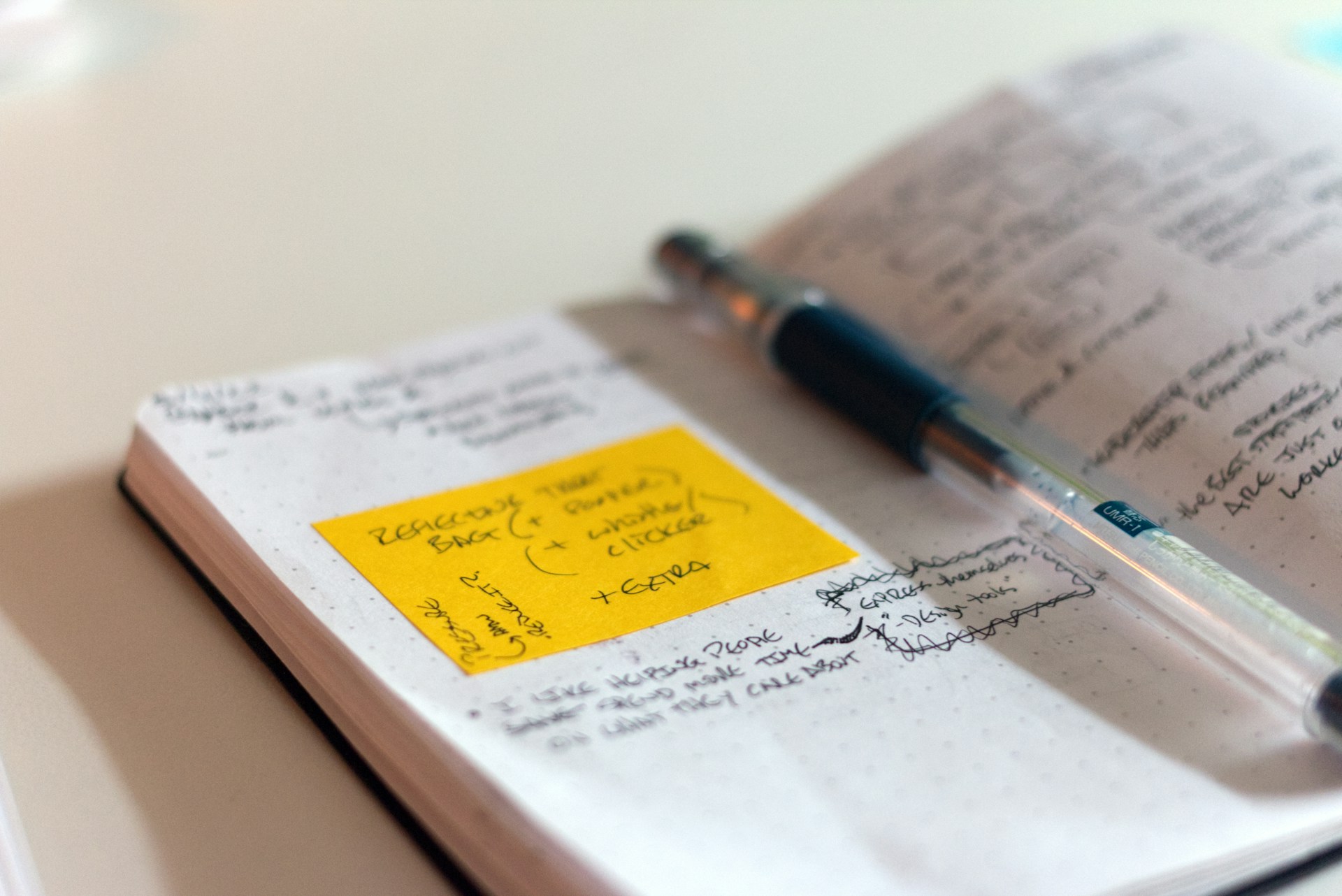
Photo by Kelsy Gagnebin on Unsplash
I know. It sounds obvious.
And yet, I often have to remind my students to write things down and make notes during class.
Writing things down helps you remember. Seeing something on a screen is simply not always as effective as physically writing it.
I personally like using different colours, drawing little pictures and organising my notes in a way that makes sense to me. It makes the information easier to process and, hopefully, easier to remember later. Your grammar notebook doesn’t have to look perfect. It just needs to be useful to you.
10. Listen to Polish songs.
Songs may not be the first thing that comes to mind when you think about learning grammar, but they can actually be incredibly useful.
Some Polish songs are packed with grammatical structures – and because music is repetitive and catchy, it can help you remember them without feeling like you are doing grammar exercises.
Learning the Polish future tense? This song can help you with that.
Struggling to remember the endings of the Locative case (miejscownik)? There is probably a Polish song that can help you.
And suddenly, instead of memorising a grammar table, you have a tune stuck in your head.
Not a bad way to learn, right?
11. Treat language apps as an additional tool, not your entire language-learning strategy.
Language apps can be really useful. They can help you stay consistent, introduce you to new vocabulary and give you a chance to revise what you have learnt in class or on your own.
But I have never, ever met anyone who successfully learnt a language just by using an app.
An app can be a great way to start your language-learning journey. It can help you build a habit and practise regularly. But sooner or later, you will need more: listening, speaking, reading, writing, real conversations and, yes, even some grammar.
Use apps as one of your tools – not the whole toolbox.
12. Expect the “I am never going to learn this” phase.

Photo by Sebastian Herrmann on Unsplash
At some point, you might feel completely overwhelmed.
Polish grammar is definitely a challenge, and there may be a moment when you look at yet another table of endings and think:
“I am never going to understand this.”
The good news is that this feeling doesn’t necessarily mean you are failing.
Quite the opposite.
Your brain is starting to notice the deeper structure of the language instead of simply seeing individual words. And that can feel confusing before it starts to feel familiar.
So, if you reach this point, give yourself a break.
Put your grammar notebook away for a few days. Come back to it when you have a little more energy. Listen to some Polish music. Watch an episode of a Polish TV series. Listen to a podcast or read a short story written in simple Polish.
And then, perhaps, you’ll suddenly notice that you understand something you didn’t understand a few weeks ago.
Maybe you recognise a grammatical structure you recently learnt.
Maybe you understand a sentence without translating it.
Those little moments are incredibly motivating.
And you may be surprised to hear this, but the “learning Polish was a huge mistake” phase often comes just before things start to click.
13. Be realistic about your goals.

Image by KamranAydinov on Magnific
Instead of constantly asking yourself:
“Do I know all the endings in all seven cases?”
ask yourself:
“Can I talk about my plans for the future in Polish?”
“Can I order food in a restaurant?”
“Can I tell someone what I had for lunch yesterday?”
These are the things that actually show you how much Polish you can use.
Remember that learning a language is a process. Nothing happens overnight. And, just like with any other skill, the key is practice.
One day – I promise! – you will use the correct case without even thinking about it. It will simply feel right.
The goal is to help you use Polish to communicate in real-life situations – with grammar quietly doing its job in the backgroud.
And if you need a little help navigating Polish grammar, check out my online Polish classes, where you can learn Polish individually or in a group.